 CompetitionX CompetitionX is the most up-to-date source for RC Car News, Reviews and Videos for Radio Control. We also have the most comprehensive Manual Database on the web.
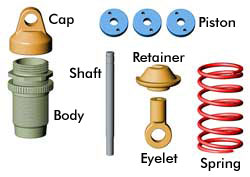
What are Shocks?
Also called Dampers, the Shocks purpose is to dampen the movements of the spring. They also affect handling conditions during cornering. Too stiff, and they can cause harshness and a bumpy ride. Too soft, and they can feel mushy and reduce responsiveness. Every part of the Shock can be tuned for the perfect Shock absortion.
Most performance vehicles have 4 shocks. They are (typically) oil filled and have adjustable pistons, springs, and travel. Other ‘entry level’ vehicles can have from 2 to 8 shocks. Entry level vehicles also have adjustable features, but typically have plastic bodies. They can be upgraded to aluminum for maximum performance.
Tuning with the Shocks
In this section we will cover the Shocks and all it’s parts: Shafts, Bodies, Pistons, Oils, and Springs.
Shock Shafts:
The Shaft runs through the entire Shock Body. Inside the Body, the Shaft has the Piston attached to it. There are a couple different types of Shock Shafts.
1) Standard Shock Shaft. Excellent unit, but not hard coated or treated with any type of covering.
2) Unobtanium Shock Shaft (Associated Upgrade Unit). Same as the Standard Shaft, but coated to produce a much smoother shock action. Highly recommended for racing.
3) MIP’s Gold Nitrade. Same as a stock unit, but Gold Nitrade coated to produce better Shock action.
4) Others. I’m sure there are other ‘coated’ Shafts available, but they’re all going to do the same basic thing. It is recommended to upgrade for a stronger, smoother Shock action.
Shock Body:
The Shock Bodies hold the Oil, Shaft and Piston and are normally made of either 2 materials: Plastic or Aluminum. While plastic units are light, they wear out fast due to the friction of the Shaft and Piston moving up and down. Plus, I’ve seen alot of people blow the plastic caps off the Shocks. Plastic Bodies use plastic threads and will not be as strong to impacts as aluminum units. It is suggested that you upgrade to Aluminum Shock Bodies for racing. It is also suggested that, if your budget allows, you upgrade to Threaded Aluminum Shock Bodies. They are far easier to tune and more precise than normal un-threaded units using pre-load spacers.
Shock Pistons:
The Piston is usually a round disc (with holes in it) attached to the Shock Shaft. Pistons can have 1, 2, 3 or more holes. The Oil travels though the holes during compression and rebound. The size or number of holes determines how fast the Oil travels through it. Larger holes (or more holes) allow Oil though quicker, making for responsive Shock damping. Smaller holes (or fewer holes) allow Oil though slower, resulting in sluggish Shock action. As a general rule, the smoother the track conditions, the smaller (or fewer) the Piston holes. The rougher or bumpier, the larger (or more) holes in the Piston.
Shock Oil:
Shock Oil determines the damping of your car. Heavy Oil will make your car seem sluggish. Lighter weight Oil will make your car seem more responsive. Oil is sold in small bottles from (usually) 10wt to 100wt. The higher the number, the heavier (or thicker) the Oil. As a general rule, lighter Oil is better for bumpy conditions, but allows more chassis roll. Heavier Oil is better for smooth tracks, but decreases responsiveness.
Shock Springs:
The purpose of the Springs is to keep the car level during acceleration, deceleration, and cornering. Springs come in many different Spring rates (or pound ratings) that are usually designated by their color. Generally, stiffer Springs make your car respond quicker and reduce chassis roll, but will not work well on bumpy tracks. Stiffer is better on smooth or high traction tracks. Softer Springs are better on slippery or bumpy tracks. You will normally run heavier Springs on the front than the rear.
Back to the RC Suspension Tuning Guide.