

RC Gear Pitch: 32P vs 48P vs 64P – Metric and Mod Gears
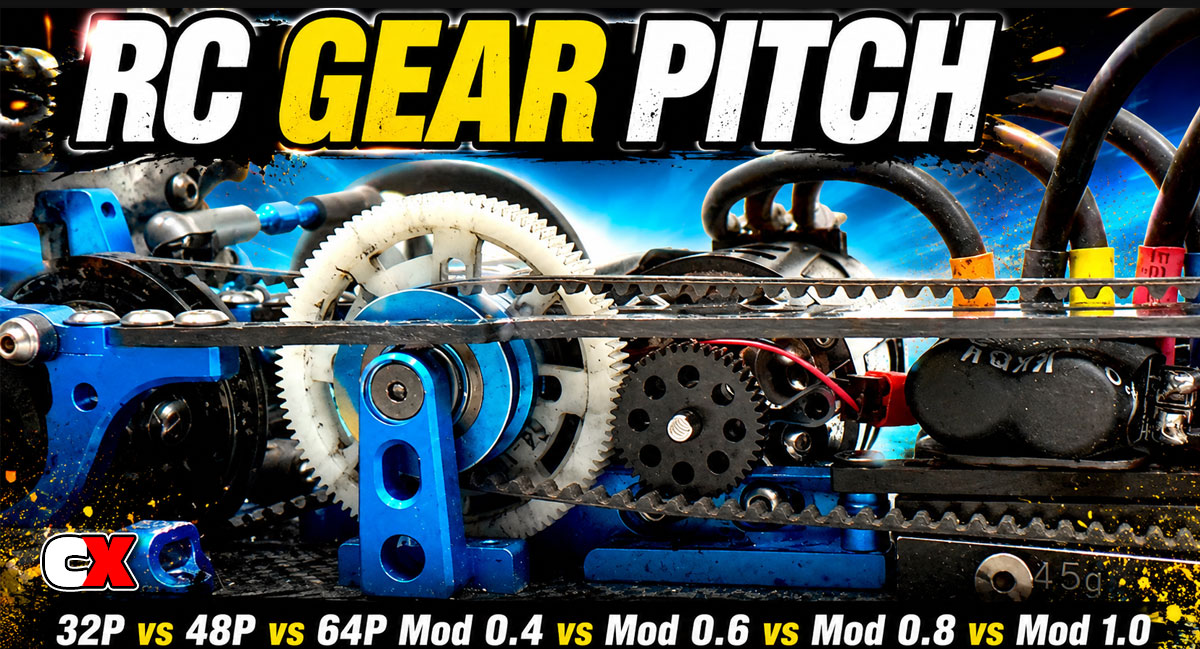
RC gearing can get confusing surprisingly fast. You start out thinking, “I just need a new pinion gear,” and five minutes later you’re staring at 32P, 48P, 64P, Mod 0.4, Mod 0.6, Mod 0.8 and Mod 1.0 wondering when buying two tiny gears became an engineering exam.
Fortunately, gear pitch is much easier to understand once you know what all those numbers actually mean.
In simple terms, gear pitch describes the size and spacing of the teeth on a gear. A coarse gear has larger, stronger teeth, while a fine-pitch gear has smaller teeth packed more closely together.
The important part is that the pinion and spur gear must use the same pitch. A 48P pinion needs a 48P spur. A Mod 0.8 pinion needs a Mod 0.8 spur.
Close enough does not count.
Imperial Pitch vs. Metric Module
Before comparing the individual sizes, there are two different measurement systems to understand.
32P, 48P and 64P use the imperial Diametral Pitch (DP) system. The number represents how many teeth the gear has per inch of pitch diameter.
Because of that, a higher pitch number means smaller teeth.
• 32P = large, coarse teeth
• 48P = medium-size teeth
• 64P = small, fine teeth
Metric gears use the Module, or Mod, system. Here, the numbers work in the opposite direction.
A larger Mod number means larger teeth.
So:
• Mod 0.4 = very fine teeth
• Mod 0.6 = medium-fine teeth
• Mod 0.8 = coarse teeth
• Mod 1.0 = very large, coarse teeth
That reversal is one reason RC gearing can initially be confusing.
• With pitch, bigger number = smaller teeth.
• With Mod, bigger number = bigger teeth.
Because apparently making one universal system would have been too easy.
32P Gears
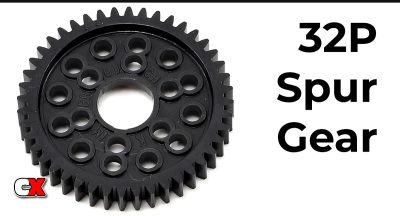 32 Pitch (32P) uses relatively large, coarse gear teeth.
The larger teeth provide more material at the contact point between the pinion and spur, making 32P gearing strong and resistant to damaged or stripped teeth. This makes it well suited to vehicles that experience heavy loads, impacts or sudden bursts of torque.
You’ll commonly find 32P gearing on vehicles such as:
• Monster trucks
• Short course trucks
• Bashers
• Higher-powered, 1/8 scale RC vehicles
Another advantage of the larger teeth is that 32P gearing tends to tolerate dirt and debris better than finer pitches.
The tradeoff is refinement. Compared with 48P or 64P, 32P gears are generally louder and don’t provide quite the same fine adjustment between gear ratios.
Think work boots rather than ballet slippers.
Shop 32P Gears
Check Price: www.AMainHobbies.com
48P Gears
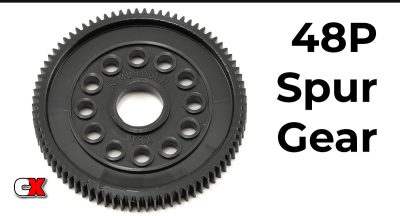 48 Pitch (48P) is one of the most common gear pitches in hobby-grade RC cars.
Its teeth are smaller than 32P but larger than 64P, putting it nicely in the middle when it comes to strength, smoothness and gearing options.
48P is commonly used in:
• 1/10-scale touring cars
• 1/10-scale offroad buggies and trucks
• 2WD and 4WD race vehicles
• General-purpose hobby-grade RC cars
For many vehicles, 48P provides an excellent compromise. The teeth are fine enough to provide plenty of gearing choices while remaining durable enough for normal racing and recreational use.
There is also a huge selection of 48P pinion and spur gears available, which makes experimenting with gearing easy.
If RC gear pitches had a “I’ll just have the cheeseburger” option, 48P would probably be it.
Shop 48P Gears
Check Price: www.AMainHobbies.com
64P Gears
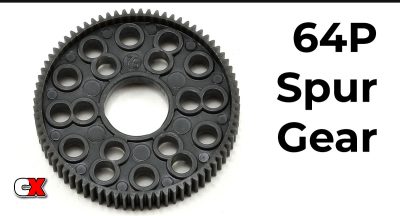 64 Pitch (64P) uses much smaller and finer teeth than 48P or 32P. The primary advantage is gearing precision.
Because the teeth are smaller, manufacturers can produce gears with more closely spaced tooth counts while keeping the physical size of the gears reasonable. This gives racers the ability to make very small changes to their gear ratio.
64P gearing is most commonly associated with applications such as:
• 1/10-scale touring cars
• Pan cars and Formula 1 cars
• Carpet racing
• High-grip on-road racing
It can also run smoother and quieter when the gears are properly aligned.
The downside is durability. Those tiny teeth are less forgiving of poor gear mesh, dirt, rocks and drivetrain movement. A pebble that a 32P gear might casually chew up and spit out could make a 64P spur gear reconsider its career choices.
For that reason, 64P is best suited to clean racing environments where precision is more important than outright toughness.
Shop 64P Gears
Check Price: www.AMainHobbies.com
Mod 0.4 Gears
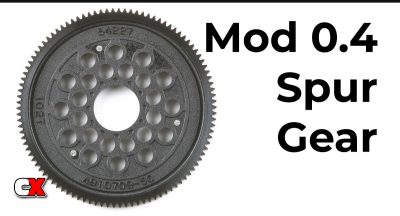 Mod 0.4 is a very fine metric gear pitch. Its tooth size is close to 64P, although the two are not identical and should not be treated as interchangeable.
Mod 0.4 gearing provides similar advantages to other fine-pitch gears: smooth operation and the ability to make small gearing adjustments.
It is commonly found in smaller or precision-oriented RC applications where large, heavy-duty teeth aren’t necessary.
Mod 0.6 Gears
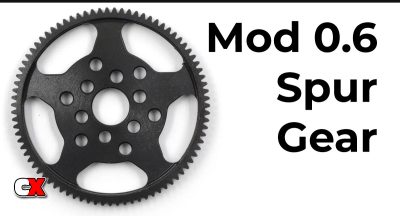 Mod 0.6 sits in the middle of the metric gear range. Its teeth are larger and stronger than Mod 0.4 but noticeably smaller than Mod 0.8.
This makes Mod 0.6 a useful compromise between smoothness, gear selection and durability.
Depending on the manufacturer and vehicle, Mod 0.6 can appear in various RC applications where a stronger drivetrain is needed without stepping all the way up to the larger teeth of Mod 0.8.
Mod 0.8 Gears
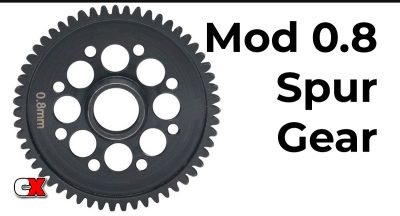 Mod 0.8 uses relatively large gear teeth and is one of the more common coarse metric gear sizes used in RC vehicles. Interestingly, Mod 0.8 is extremely close in tooth size to 32P.
Mathematically, 32P converts to approximately Mod 0.794, which explains why the gears look almost identical. However, they are not technically the same standard.
Because of their similarity, you’ll occasionally see RC enthusiasts discuss using 32P and Mod 0.8 gears together. While they may appear to mesh, the safest approach is to use matching gears designed for the same standard.
Mod 1.0 Gears
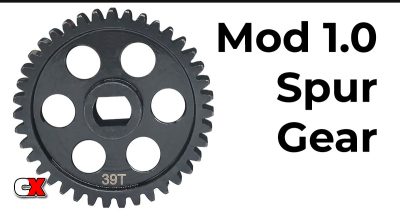 Mod 1.0 steps things up another level. These gears have large, widely spaced teeth designed to handle substantial loads.
You’ll often find Mod 1.0 gearing in:
• Large-scale RC vehicles
• High-powered bashers
• Heavy vehicles
• Powerful brushless applications
• Drivetrains experiencing high torque loads
The big advantage is strength. Large teeth provide more material to handle the forces being transferred from the motor through the drivetrain.
The disadvantage is that Mod 1.0 isn’t intended for extremely fine gearing adjustments. The gears can also be physically larger and noisier than finer-pitch alternatives as well.
But if your RC vehicle has enough power to launch itself into another ZIP code, ultra-delicate 64P gearing probably wasn’t on the shopping list anyway.
Shop Mod-Pitch Gears
Check Price: www.AMainHobbies.com
RC Gear Pitch Comparison
Here’s the easiest way to visualize the differences:
| Gear Type | Relative Tooth Size | Typical Characteristics |
|---|---|---|
| 64P | Very fine | Maximum gearing precision |
| Mod 0.4 | Very fine | Smooth, precise metric gearing |
| 48P | Fine/medium | Excellent all-around compromise |
| Mod 0.6 | Medium | Balance of strength and refinement |
| 32P | Coarse | Strong and durable |
| Mod 0.8 | Coarse | Strong metric gearing |
| Mod 1.0 | Very coarse | Heavy-duty/high-power applications |
One thing worth repeating: similar tooth sizes do not automatically make two gear standards interchangeable. Whenever possible, match the pitch or module of the pinion to the spur gear exactly.
Why Would You Change Gear Pitch?
Changing gear pitch is different from simply changing your gear ratio.
When you swap from a 20T pinion to a 22T pinion, for example, you’re changing the ratio.
When you switch from 48P to 32P, you’re changing the physical tooth size and spacing of the entire gear system. That means you’ll normally replace both the pinion and spur gear.
There are several good reasons to do this.
Switching to a Coarser Gear Pitch
You might move from a finer gear pitch to something coarser when durability becomes more important.
For example:
• 64P to 48P
• 48P to 32P
A coarser gear pitch gives you larger, stronger teeth. This can be useful when increasing motor power, running a heavier vehicle or driving somewhere dirt and debris can reach the gears.
It’s also useful if you have a habit of destroying spur gears. At some point, repeatedly replacing the same gear stops being maintenance and starts becoming a subscription service.
The tradeoff is that you may lose some gearing precision.
Switching to a Finer Gear Pitch
Going the opposite direction can make sense when precision becomes more important than durability.
For example:
• 32P to 48P
• 48P to 64P
Smaller teeth allow more gearing combinations within a similar physical space. This gives racers finer control over their final gear ratio.
Instead of making a relatively large jump between two gearing combinations, a finer pitch may allow you to make smaller changes. That can be useful when you’re trying to squeeze the last little bit of performance from a race car.
The tradeoff here is that they’re less tolerant of dirt, poor gear mesh and drivetrain movement.
How to Switch Gear Pitch
Changing pitch generally requires replacing both gears in the primary reduction: old pinion + old spur to new pinion + new spur. Both new gears must use the same pitch.
You should also choose tooth counts that produce approximately the same gear ratio as your original setup if your goal is only to change gear pitch rather than change the vehicle’s gearing.
For example, don’t simply replace a 48P spur with a 32P spur that happens to have the same number of teeth. The physical diameters will be different because the tooth size is different.
Instead, calculate or select a pinion-and-spur combination in the new pitch that gives you the ratio you’re looking for. You’ll also need to reset the gear mesh after installing the new gears.
The basic idea is to choose your desired ratio, then find an appropriate spur and pinion combination in the new pitch. Install both and reset the gear mesh.
FAQ
Q: Can I use a 48P pinion with a 32P spur gear?
A: No. The tooth size and spacing are different, so the gears will not mesh correctly. Always match the pinion and spur gear pitch.
Q: Are 32P and Mod 0.8 gears the same?
A: Not, but they are extremely close. 32P works out to approximately Mod 0.794, while Mod 0.8 is exactly Mod 0.8. Because the difference is tiny, they can look almost identical, but they are different standards. Using matching gears is the better choice.
Q: Are 64P and Mod 0.4 the same?
A: No. Again, similar in size but not identical. A 64P gear corresponds to approximately Mod 0.397, making it extremely close to Mod 0.4. They should still be treated as separate standards.
Q: Which gear pitch is strongest?
A: Of the gear pitches covered here, Mod 1.0 has the largest teeth and is well suited to high-load applications. However, gear strength also depends on the material, gear width, quality, alignment and drivetrain design.
Q: Is 32P stronger than 48P?
A: Generally, 32P is more resistant to damaged or stripped teeth because its teeth are larger and more robust. That’s one reason coarse pitches are popular in bashers and powerful RC vehicles.
Q: Why do racers use 64P gears?
A: 64P allows very fine adjustments to gear ratios and can provide smooth operation. This makes it useful in racing classes where small gearing changes can affect lap times and motor performance.
Q: Why is 48P so common?
A: 48P provides a good compromise between durability, smooth operation and gearing choices. There’s also a huge selection of compatible pinion and spur gears available.
Q: Can changing gear pitch make my RC car faster?
A: Not by itself.
Gear pitch determines the size and spacing of the teeth, while the Gear Ratio determines how the gearing affects acceleration, motor RPM and potential top speed.
If you change from 48P to 32P while maintaining essentially the same ratio, the vehicle’s overall gearing remains essentially the same. You changed the gears, not the laws of physics.
Q: Do I need to replace both gears when changing pitch?
A: Yes. If you’re converting to a different pitch, replace both the pinion and spur so they use the same gear standard.
Q: Why would I switch from 48P to 32P?
A: Durability is usually the main reason. A powerful basher, heavier vehicle or RC car used in dirty conditions may benefit from the larger, stronger teeth of 32P gearing.
Q: Why would I switch from 48P to 64P?
A: Precision. A racer may prefer 64P because the finer teeth allow smaller gearing changes. The downside is that the gears require better alignment and are more vulnerable to debris and drivetrain movement.
Q: Is a higher gear pitch stronger?
A: Not in the Imperial pitch system.
With 32P, 48P and 64P, higher numbers mean smaller teeth. Therefore, 32P has larger teeth than 48P, and 48P has larger teeth than 64P.
Metric Module works the other way around: Mod 1.0 has larger teeth than Mod 0.8, which has larger teeth than Mod 0.6.
Related Tuning Adjustments
Here are some other articles regarding RC Gear Pitch and Ratio:
• RC Gear Pitch Explained
• RC Gear Ratio

