
RC ESC Boost Timing Explained
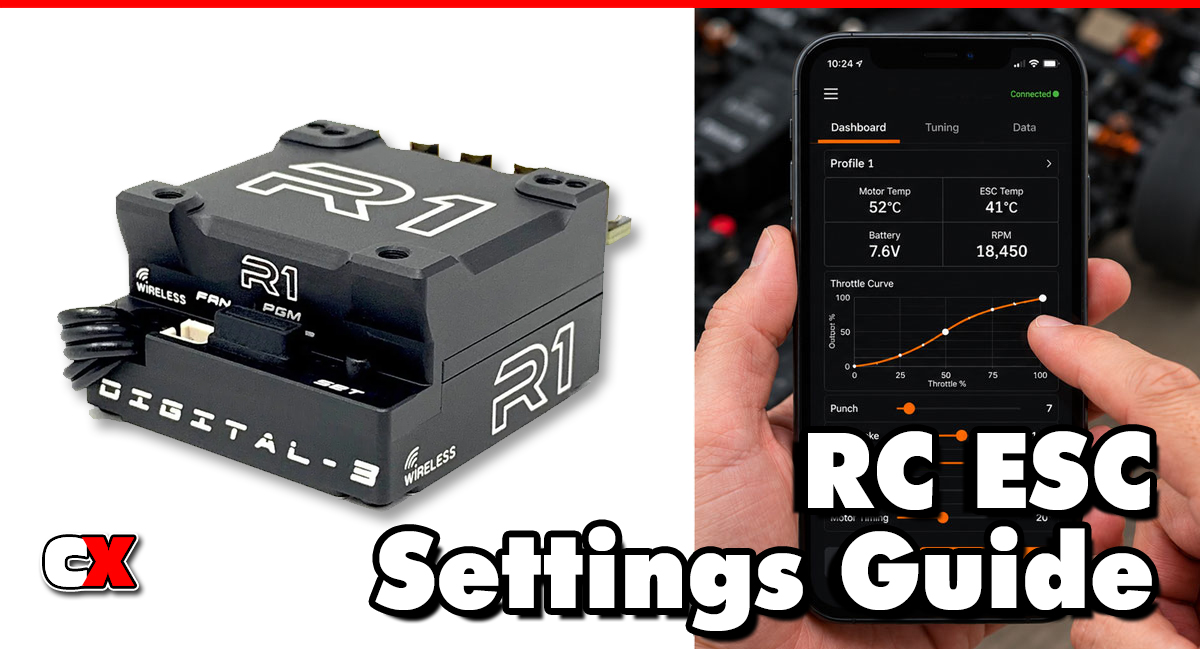
What Is Boost Timing?
Boost Timing is an electronic timing advance feature found in many racing-oriented brushless ESCs. It automatically adds motor timing as RPM increases.
Unlike static motor timing, which remains constant throughout the entire throttle range, Boost Timing dynamically increases timing based on motor speed or throttle position. The ESC gradually applies additional timing while the vehicle accelerates, increasing motor efficiency and RPM.
Think of Boost Timing as a way to provide more power and top-end speed without affecting low-speed drivability as much as adding the same amount of static timing.
Most modern ESCs allow you to adjust:
• Start RPM
• End RPM
• Boost Timing amount (degrees)
• Activation rate
• Timing curve
The ESC uses these parameters to determine when and how quickly additional timing is applied.
How Does Boost Timing Affect Your Car?
Boost Timing primarily affects acceleration, top speed, motor temperature and overall power delivery.
More Boost Timing
Increasing Boost Timing generally results in:
• Higher top speed
• Increased motor RPM
• More aggressive mid-range acceleration
• Greater straightaway speed
• Increased motor and ESC temperatures
• Higher battery consumption
When the ESC adds timing during acceleration, the motor spins faster for a given throttle position. This can make the car feel more powerful on long straightaways and larger tracks.
However, excessive Boost Timing can create overheating issues and reduce efficiency.
Common Symptoms of Too Much Boost Timing
• Motor running excessively hot
• ESC temperatures increasing
• Reduced runtime
• Vehicle feels difficult to drive
• Loss of punch exiting corners due to overheating
• Thermal shutdowns
Less Boost Timing
Reducing Boost Timing generally results in:
• Lower motor temperatures
• Increased runtime
• Smoother power delivery
• Better drivability
• Reduced top speed
• Improved consistency over long race durations
Many racers reduce Boost Timing on technical tracks where corner speed matters more than maximum straightaway speed.
How Do You Change Boost Timing?
The exact procedure depends on your ESC manufacturer, but the process is generally similar.
Method 1: ESC Programming Box
Most racing ESCs use a programming box.
1. Connect the programming box to the ESC.
2. Enter the timing menu.
3. Locate the Boost Timing setting.
4. Increase or decrease the timing value.
5. Save the changes.
6. Test drive the vehicle.
Method 2: Smartphone App
Some ESCs use Bluetooth or Wi-Fi connectivity.
1. Open the ESC programming app.
2. Connect to the ESC.
3. Navigate to timing settings.
4. Adjust Boost Timing.
5. Save the profile.
6. Test the vehicle.
Method 3: ESC Software
Certain ESCs allow adjustments through PC software.
1. Connect the ESC to your computer.
2. Open the manufacturer’s software.
3. Access timing settings.
4. Modify Boost Timing values.
5. Save the configuration.
6. Test and monitor temperatures.
When To Change Boost Timing
Boost Timing should be adjusted when you need to balance speed, drivability and temperature.
Increase Boost Timing When:
• The track has a long straightaway.
• You need additional top speed.
• Motor temperatures are low.
• Acceleration feels weak in the mid-range.
• Competitors are pulling away on straights.
Reduce Boost Timing When:
• Motor temperatures exceed safe limits.
• ESC temperatures become excessive.
• Runtime is too short.
• The track is small and technical.
• The vehicle becomes difficult to control.
Typical Racing Situations
Small Indoor Tracks
Most racers use lower Boost Timing settings because corner speed is more important than maximum RPM.
Large Outdoor Tracks
Higher Boost Timing is often beneficial because the car spends more time at high speed.
High-Grip Conditions
Additional Boost Timing can help maximize acceleration and straightaway performance.
Low-Grip Conditions
Reducing Boost Timing can improve control and make the car easier to drive.
What To Check After Boost Timing
After making any Boost Timing adjustment, perform several checks before continuing to increase timing.
Motor Temperature
This is the most important measurement.
Most brushless racing motors should remain below approximately:
• 160°F (71°C) for conservative operation
• 180°F (82°C) as a common upper limit
Always follow the motor manufacturer’s recommendations.
ESC Temperature
Monitor ESC temperature after every run. Excessive Boost Timing can create additional load that raises ESC temperatures significantly.
Battery Temperature
More timing typically increases current draw. Check battery temperatures after a full run to ensure the pack remains within safe operating limits.
Drivability
Pay attention to:
• Corner exit speed
• Mid-range acceleration
• Straightaway performance
• Consistency throughout a run
The fastest setup is not always the one with the highest timing value.
Runtime
Higher Boost Timing consumes more energy. If race duration is important, verify that your battery can complete the event comfortably.
Basic Boost Timing vs Advanced Settings
Many racers focus only on the Boost Timing value itself, but modern ESCs often provide additional timing controls.
Basic Boost Timing Settings
Basic adjustments usually include:
• Boost Timing amount
• On or off functionality
• Simple RPM activation
These settings are ideal for beginners because they provide noticeable performance gains without excessive complexity.
Advanced Boost Timing Settings
Advanced ESCs may allow adjustment of:
Start RPM
Determines when Boost Timing begins.
Lower Start RPM:
• Timing activates sooner
• Stronger mid-range power
Higher Start RPM:
• Timing activates later
• Smoother acceleration
End RPM
Determines when maximum timing is reached.
A lower End RPM creates a more aggressive timing curve.
A higher End RPM creates a smoother power delivery.
Timing Ramp Rate
Controls how quickly timing increases.
Faster ramp rates:
• More aggressive acceleration
• Stronger punch
Slower ramp rates:
• Smoother feel
• Easier driving
Turbo Timing Interaction
Many racing ESCs combine Boost Timing with Turbo Timing. Boost Timing typically activates throughout the RPM range, while Turbo Timing activates near full throttle.
Understanding how these two systems work together can provide significant tuning advantages for experienced racers.
FAQ
Q: Is Boost Timing the same as Turbo Timing?
A: No. Boost Timing increases timing progressively as RPM rises, while Turbo Timing typically activates at high throttle positions or full throttle.
Q: Does Boost Timing increase top speed?
A: Yes. Increasing Boost Timing generally increases motor RPM and straightaway speed.
Q: Does Boost Timing increase motor temperature?
A: Yes. More Boost Timing almost always increases motor temperature and current draw.
Q: Can too much Boost Timing damage my electronics?
A: Excessive Boost Timing can cause overheating which may shorten the lifespan of motors, ESCs and batteries.
Q: Should beginners use Boost Timing?
A: Yes, but conservatively. Small adjustments allow beginners to learn how timing affects performance without creating reliability problems. Note that Boost Timing and Turbo Timing are not allowed in most racing classes.
Q: How much Boost Timing should I start with?
A: A good starting point is often 5° to 10° of Boost Timing for many stock racing applications (if allowed). Always follow your ESC and racing class rules.
Q: Does Boost Timing work with sensorless systems?
A: Some sensorless ESCs offer timing adjustments, but Boost Timing is most commonly found in sensored racing ESCs.
Q: Is more Boost Timing always faster?
A: No. Excessive timing can reduce efficiency, increase heat and make the vehicle harder to drive. The fastest setup is usually the one that balances speed, consistency and reliability.
Back to the RC ESC Settings Guide.

