
RC ESC Throttle Curve Explained
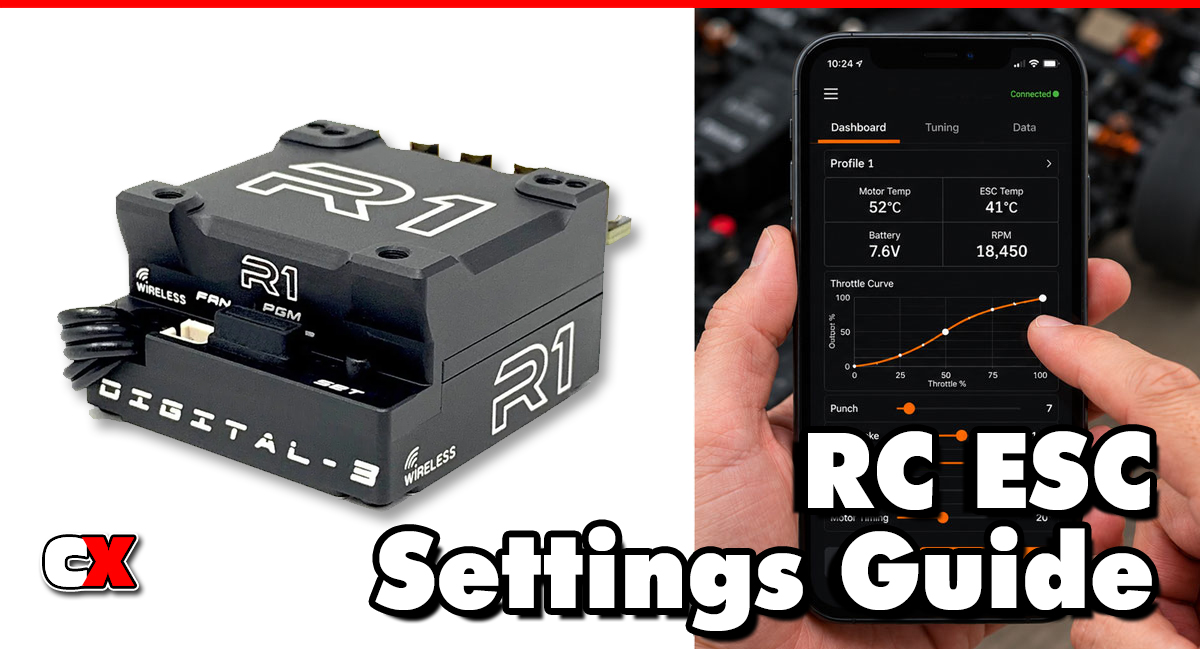
What Is Throttle Curve?
Throttle Curve is an ESC setting that changes the relationship between transmitter trigger position and motor output.
In a linear Throttle Curve, the ESC delivers power proportionally to trigger movement. For example:
• 25% trigger = 25% motor output
• 50% trigger = 50% motor output
• 75% trigger = 75% motor output
• 100% trigger = 100% motor output
With an adjustable Throttle Curve, the ESC can alter this relationship.
A softer Throttle Curve provides less motor output during the early portion of trigger travel and ramps power in more gradually.
An aggressive Throttle Curve provides more motor output earlier in trigger travel, making the vehicle feel more responsive.
The maximum power at full throttle remains unchanged. The setting only affects how power is delivered between neutral and full throttle.
Common Throttle Curve Types
Linear Curve
Provides a direct 1:1 relationship between trigger movement and motor output.
Exponential (Soft) Curve
Reduces throttle sensitivity near neutral and increases power gradually as trigger travel increases.
Aggressive Curve
Increases throttle sensitivity early in trigger travel, providing stronger acceleration with less trigger movement.
Custom Curve
Some advanced ESCs allow multiple adjustment points so drivers can create a custom power delivery profile.
How Does Throttle Curve Affect Your Car?
Throttle Curve primarily affects drivability, traction and driver confidence.
Softer Throttle Curve
A softer Throttle Curve:
• Reduces wheelspin
• Makes acceleration smoother
• Improves control on slippery surfaces
• Helps prevent traction rolling
• Makes powerful brushless systems easier to drive
• Increases consistency during long races
Aggressive Throttle Curve
An aggressive Throttle Curve:
• Increases initial acceleration feel
• Improves responsiveness exiting corners
• Makes the vehicle feel more powerful
• Requires less trigger movement for acceleration
• Can improve reaction times in racing situations
Effects on Lap Times
Throttle Curve does not directly increase motor power. Instead, it allows drivers to apply available power more effectively. A properly adjusted Throttle Curve can improve:
• Corner exit consistency
• Vehicle stability
• Traction management
• Driver confidence
• Overall lap times
In many cases, smoother power delivery results in faster and more consistent racing than an aggressive setup.
How Do You Change Throttle Curve?
The exact procedure depends on your ESC manufacturer and model.
Most modern ESCs allow Throttle Curve adjustments through:
• ESC programming box
• Smartphone app
• Bluetooth module
• LCD programmer
• PC software
General Adjustment Procedure
Step 1: Connect to the ESC
Use the programming method recommended by the manufacturer.
Step 2: Locate the Throttle Curve Setting
This may be labeled as:
• Throttle Curve
• Throttle Profile
• Throttle Response Curve
• Acceleration Curve
• Power Curve
Step 3: Select a Curve Type
Choose:
• Linear
• Soft
• Aggressive
• Custom
Step 4: Adjust Curve Points
Advanced ESCs may allow multiple adjustment points across the throttle range.
Typical adjustments include:
• Initial throttle sensitivity
• Mid-range response
• High-throttle response
Step 5: Save Settings
Store the new configuration in the ESC.
Step 6: Test Drive
Drive the vehicle and evaluate throttle feel before making additional changes.
When To Change Throttle Curve
Throttle Curve adjustments should be made when vehicle behavior does not match track conditions or driving style.
Reduce Wheelspin
If the vehicle spins the tires excessively under acceleration, a softer Throttle Curve can improve traction.
Improve Corner Exit Control
If the vehicle becomes difficult to control when exiting corners, smoothing the lower portion of the Throttle Curve can help.
Increase Responsiveness
If acceleration feels lazy or delayed, a more aggressive Throttle Curve may improve throttle feel.
Adapt to Surface Conditions
Different track surfaces often require different power delivery characteristics.
Examples include:
| Surface Type | Recommended Throttle Curve |
|---|---|
| Loose dirt | Soft |
| Wet surface | Soft |
| Clay track | Linear |
| Carpet track | Aggressive |
| Drag strip | Aggressive |
| Rock crawling | Very Soft |
Match Driver Skill Level
Newer drivers often benefit from softer Throttle Curves because they make the vehicle easier to control.
Experienced racers may prefer more aggressive curves for quicker response.
What to Check After Adjusting Throttle Curve
After changing Throttle Curve, evaluate several aspects of vehicle performance.
Acceleration Smoothness
Check whether acceleration feels predictable and easy to control.
Corner Exit Traction
Observe whether the vehicle gains traction effectively when accelerating out of turns.
Trigger Sensitivity
Ensure the vehicle responds naturally to trigger movement.
Vehicle Stability
Watch for:
• Wheelspin
• Traction rolling
• Oversteer
• Sudden acceleration spikes
Driver Confidence
A properly adjusted Throttle Curve should make the vehicle feel easier and more comfortable to drive.
Motor and ESC Temperatures
Throttle Curve normally has minimal effect on temperatures, but any major setup change should be followed by a temperature check.
Basic Throttle Curve vs Advanced Settings
Understanding where Throttle Curve fits within ESC tuning is important because several other settings influence acceleration.
Basic Throttle Curve Settings
Most ESCs provide simple options such as:
• Linear
• Soft
• Aggressive
These settings change overall throttle response with minimal tuning complexity.
Benefits include:
• Easy adjustment
• Quick testing
• Suitable for most drivers
Advanced Throttle Curve Settings
High-end racing ESCs often allow detailed curve editing.
Advanced options may include:
• Multiple throttle points
• Adjustable curve segments
• Separate low-speed and high-speed response adjustments
• Custom power delivery profiles
• Multiple stored profiles
Advanced tuning allows drivers to:
• Fine-tune corner exit behavior
• Improve traction on difficult surfaces
• Match vehicle response to driving style
• Create different setups for changing track conditions
For most racers, small adjustments often produce the best results.
FAQ
Q: Does Throttle Curve increase top speed?
A: No. Throttle Curve changes how power is delivered throughout trigger travel. Full-throttle power remains unchanged.
Q: Does Throttle Curve increase acceleration?
A: It can make acceleration feel stronger by delivering power earlier in trigger movement, but it does not create additional motor power.
Q: Should beginners use a soft Throttle Curve?
A: Yes. A softer Throttle Curve often makes vehicles easier to drive and reduces accidental wheelspin.
Q: Is Throttle Curve the same as Punch Control?
A: No. Punch Control limits how quickly power is applied. Throttle Curve changes the relationship between trigger position and motor output.
Q: Is Throttle Curve the same as a radio Throttle Exponential setting?
A: No. Radio throttle exponential modifies the transmitter signal before it reaches the ESC. Throttle Curve is processed inside the ESC itself.
Q: Can Throttle Curve improve lap times?
A: Yes. Better throttle control often improves consistency, traction and corner exits. This can, in turn, lead to faster lap times.
Q: What is the best Throttle Curve setting?
A: There is no universal best setting. The ideal Throttle Curve depends on track conditions, vehicle type, motor power, traction level and driver preference.
Back to the RC ESC Settings Guide.

